
Models are no longer the bottleneck
The limiting factor is whether AI can securely reach your knowledge, workflows, and operating context.
Most organizations today
Tools purchased before readiness gaps are known
Tool sprawl across disconnected systems
Knowledge too scattered for AI to use reliably
Staff unprepared when the rollout arrives
What readiness looks like
Entry point matched to where your organization actually is
Governance and operating boundaries set before go-live
Workflows and knowledge mapped and ready to use
People prepared to adopt and adapt with confidence
Why now
AI improvements are increasing the leverage each team can create, but they are also raising the cost of poor implementation, weak governance, disconnected knowledge, and teams that have not been prepared to use the systems well.
The limiting factor is whether AI can securely reach your knowledge, workflows, and operating context.
Public-sector offices, operational businesses, and nonprofits are being asked to do more without adding headcount.
When public trust, compliance, and institutional memory matter, generic SaaS AI experimentation is not enough.
The problem
These symptoms usually show up before a rollout succeeds. If they sound familiar, the issue is probably not the model. It is the foundation underneath it.
Departments are moving ahead on their own, creating tool sprawl and inconsistent practices before shared controls are in place.
Interest is high, but teams still lack role-specific guidance, shared practices, and confidence about when or how to rely on AI.
Our thesis
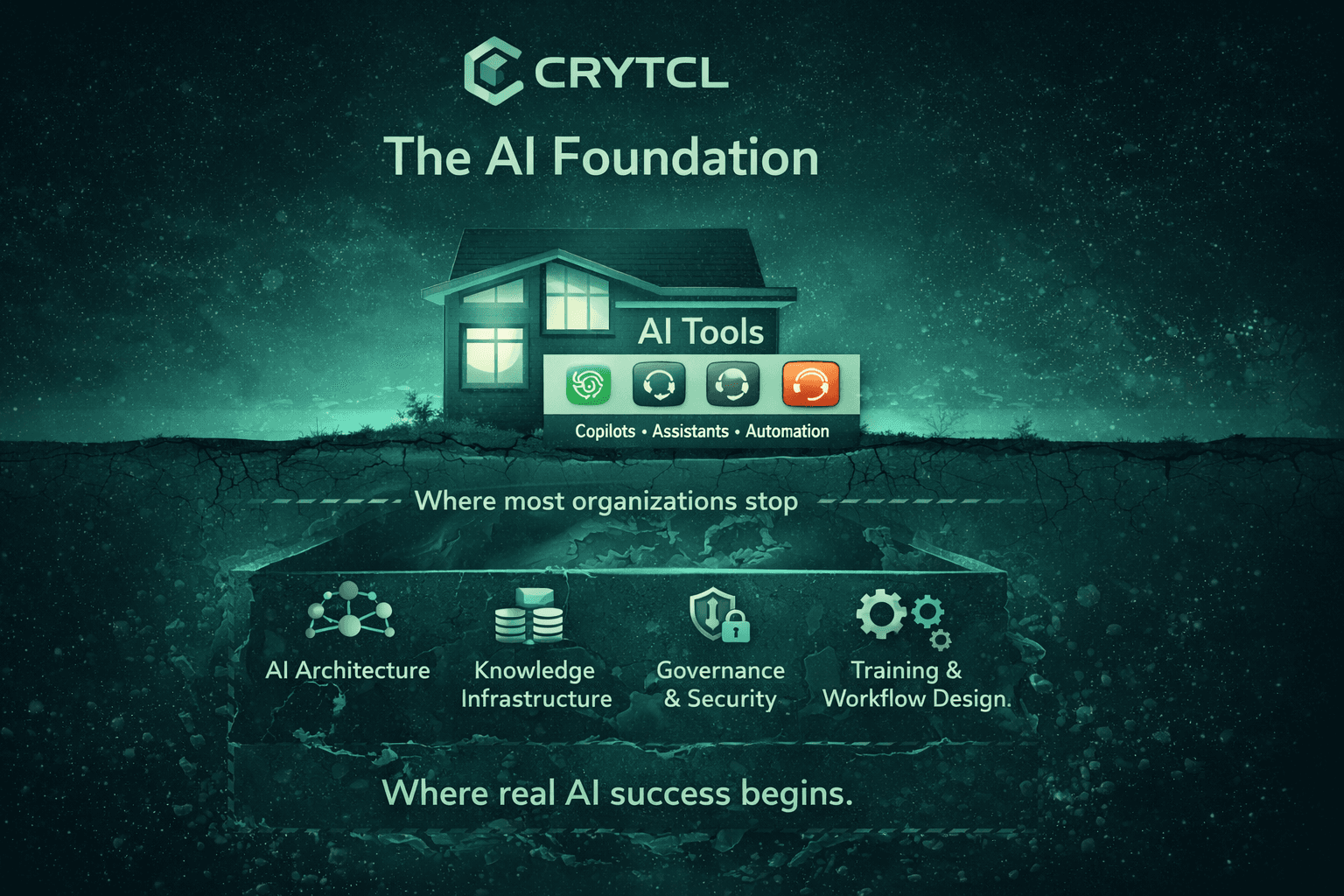
Models think. Systems win.
The model is not the bottleneck. The architecture underneath it is. Most AI programs stall because organizations skipped the knowledge layer, governance model, and operating design that make any tool actually work. That foundation is where we start.
Signal
Resource
Get the AI Readiness Guide — five areas to assess before deploying AI.
Core services
Crytcl is an AI readiness and implementation advisor for organizations that need AI to work in production. We cover knowledge infrastructure, governance, and change readiness so that adoption decisions hold up after launch — not just during the pilot.
We help you decide where AI fits, where it does not, and what has to be in place before adoption adds risk.
We map and design the knowledge layer AI needs to produce useful, traceable answers: your data sources, retrieval architecture, access controls, and the gaps that will stop even a well-chosen model from working.
We prepare your leaders, staff, and operating practices for AI so adoption holds after the rollout, not just during it.
We design the security boundaries, governance policies, review cadence, and system architecture behind trustworthy AI — so the operating model holds after the rollout, not just during it.
Client outcomes
Kevin Hein, Senior Analyst, Tirias Research
Public sector | 2-week readiness review
A K-12 district avoided a $40K tool purchase after a readiness review identified three workflow gaps the vendor had not addressed.
— Technology Director, K-12 school district
Nonprofit | governance planning
A 35-person regional nonprofit completed a governance framework before the board's first AI policy review and passed without a revision request.
— Executive Director, regional nonprofit
Manufacturing | knowledge implementation
A 60-person operation redirected its AI budget from a generic copilot toward a targeted knowledge system for field operations.
— Operations Lead, regional manufacturing firm
Representative outcomes. Results vary by organization size, starting point, and risk profile.
Engagement models
The right engagement depends on team size, operational risk, and how much training and operating change you need in place.
Bought tools but adoption stalled?
→ Readiness Review
Need board or governance alignment?
→ Implementation Roadmap
Building AI across multiple teams?
→ Program & Platform Design
Readiness Review
1-2 weeks5-25 person teams
For school districts, city halls, nonprofits, clinics, and small operators that need a practical AI starting point.
Best for you if
What you leave with
+ 2 more deliverables
Implementation Roadmap
2-3 weeks25-250 person organizations
For growing teams that need workflow design, governance, change readiness, and a phased plan to move from AI interest to operational use.
Best for you if
What you leave with
+ 2 more deliverables
Program & Platform Design
Multi-phaseEnterprise and high-consequence programs
For regulated, multi-team environments that need deeper architecture, deployment planning, change readiness design, and governed execution.
Best for you if
What you leave with
+ 2 more deliverables
Next step
A free 20-minute call. We'll understand your organization, constraints, and goals — then recommend the right starting point without pressure to buy anything.
Engagements are scoped to your size — not enterprise pricing.
What happens on the call